Have you ever submitted dozens of online job applications only to hear absolute silence in return? You are not alone. With over 63 percent of companies relying on automated software tools to screen candidates, job hunting online can feel like throwing your resume into a black hole. That is precisely why live campus hiring events are seeing such a massive surge in popularity. Recent university benchmark data shows that 93.9 percent of higher education institutions now host in-person career fairs.³ Student participation at these live events has jumped dramatically as job seekers realize the power of meeting recruiters face to face.³
In fact, Handshake reports that 69 percent of students find it much easier to build meaningful professional connections in person than through digital screens.²
So what does this mean for your job hunt? It means getting in front of a real human gives you a massive advantage. Over 45 percent of students who attend a college career fair receive an invitation for a post-fair interview, and nearly 25 percent walk away with a direct job or internship offer.¹
Meeting recruiters live lets you get an insider perspective on company culture. You get to hear how employees talk about their daily work, see how they interact, and ask direct questions. It moves you out of the generic applicant stack and puts a human face to your name.
Mastering Resume and Pitch Preparation
Before you step into a crowded fair, you need to sharpen two core tools: your resume and your elevator pitch.
Recruiters spend about six seconds scanning a paper resume during a busy event. They do not have time to read long paragraphs about every responsibility you had at a summer job. They want quick proof that you possess the exact skills they need. Around 65 to 70 percent of hiring managers now focus on skills-based hiring rather than GPA cutoffs. In fact, only 38 percent of recruiters use GPA as an initial screening tool. Keep your resume bullet points focused on clear outcomes, such as specific technical tools you used or actual results you achieved.
Next comes your elevator pitch. Forget reciting your entire resume line by line. A great pitch takes 30 to 60 seconds and follows a quick formula:
• Who you are: State your name, major, and graduation timeline clearly.
• What you have done: Highlight a key project, technical skill, or relevant experience.
• Why this company: Mention a specific initiative, team, or product of theirs that caught your attention.
• An engaging question: End with a sharp question that gets the recruiter talking.
Like, you might say: "Hi, I'm Alex, a junior studying Computer Science. Last semester, I built a data pipeline project using Python and SQL. I saw your engineering team is scaling cloud infrastructure for early-career hires, so what specific skill sets are your team leaders prioritizing right now?"
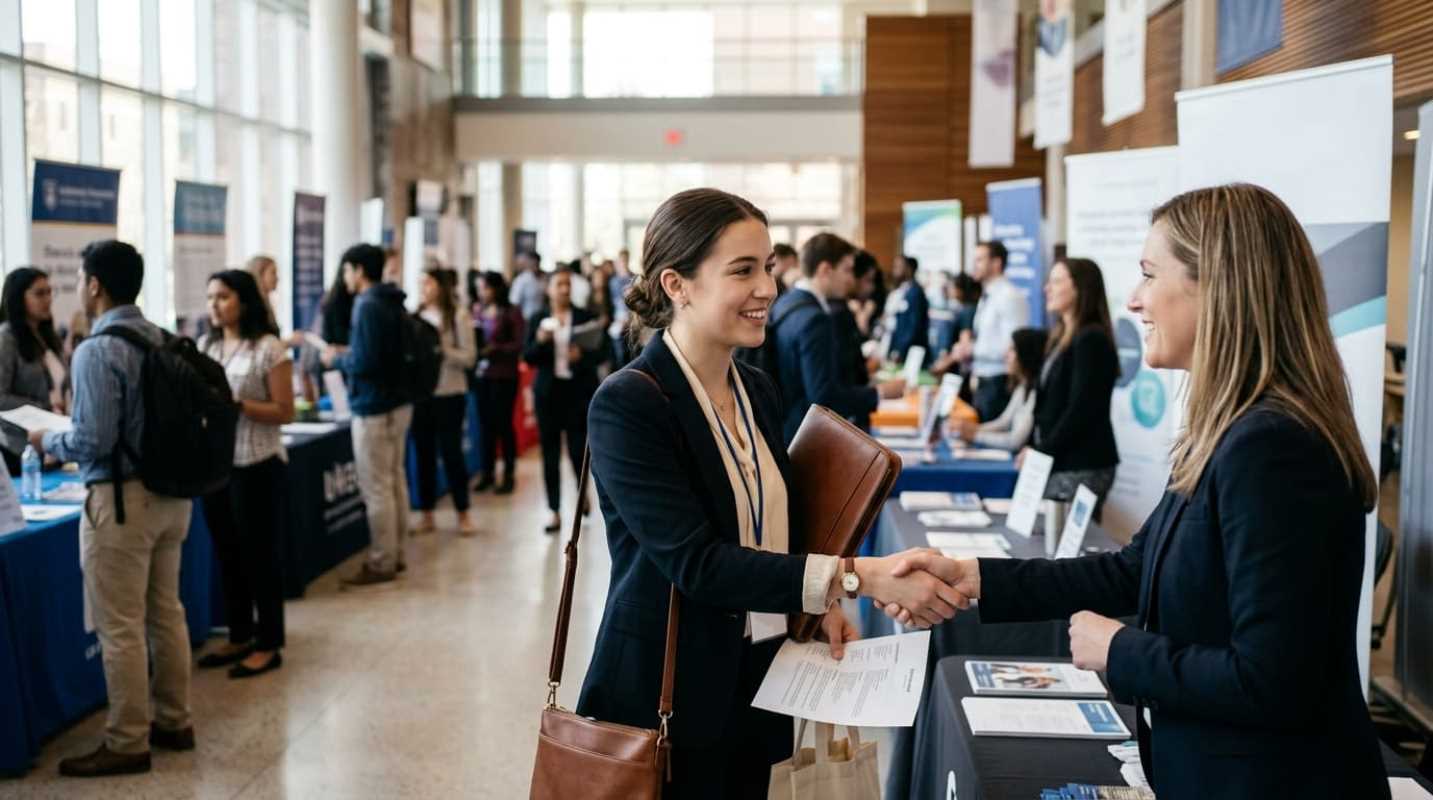
Print 15 to 20 paper copies of your resume. Keep them flat in a neat leather folder or portfolio so you can hand them over instantly without digging through a backpack.
Strategic Employer Networking Tactics
Walking into a noisy room packed with dozens of employer booths can feel a lot of. Having a structured game plan keeps you relaxed and focused.
Start by reviewing the employer list on your school portal a few days before the event. Split your target companies into two groups: your top-choice employers and your secondary choices.
Here is a simple tactic that experienced candidates use: do not visit your top target employer first. Head to a secondary choice on your list to practice your pitch, get comfortable talking to recruiters, and shake off any initial jitters. Once you feel warm and confident, head straight over to your top targets.
When you walk up to a booth, make solid eye contact and offer a firm handshake. Do not ask basic questions that you could easily answer by looking at their website homepage. Skip generic questions like "What does your company do?" and ask questions that show real preparation.
• Program success: What distinguishes early-career hires who excel in your rotational program?
• Skill development: How does your department support professional development for new team members?
• Project priorities: What types of projects do entry-level hires typically work on during their first six months?
The moment you step away from a booth, pull out your phone or a notebook. Jot down 2 to 3 notes, including the recruiter's name, their contact email, and one specific anecdote or piece of advice you discussed. You will need those details for your follow-up.
The Art of Follow-Up Etiquette
The career fair does not end when you walk out of the building. In fact, the work you do in the 24 to 48 hours after the event often decides whether you get called in for an official interview.
Recruiters speak with hundreds of candidates in a single afternoon. If you wait a week to reach out, memories fade, and notes get archived. Send a personalized follow-up email or LinkedIn connection request within a day or two while the conversation is still fresh.
When writing your follow-up message, use a simple formula that connects advice to action:
1. Thank them: Express genuine appreciation for their time at the event.
2. Reference a specific detail: Bring up a precise topic or piece of advice you discussed at the booth.
3. Show action: State that you completed the formal application based on their recommendation.
4. Reiterate enthusiasm: Reaffirm why you are excited about the role.
A quick email proves that you listen, take initiative, and follow through. Recruiters regularly cite candidate follow-through as a major factor when deciding who advances to official interviews.
Turning Fair Connections Into Job Offers
After you hand out your resumes and send your follow-up emails, managing expectations becomes your next job. Understanding how corporate hiring works keeps you patient. The average duration between an initial interview and a formal offer is about 27 days. Many organizations view campus fairs as the main pipeline for summer internship programs, which directly feed full-time hiring. In fact, the average conversion rate for interns into full-time hires stands at 63.1 percent.
When you submit formal applications online after the event, you are no longer just another random name in a database. You are a warm lead. Some firms even run live digital workflows at their booths, allowing recruiters to flag candidates for immediate on-site or virtual interviews while initial impressions are fresh.
Keep those professional connections active even if an open position is not available right away. Connect on LinkedIn, follow company updates, and send a friendly update when you complete an important project or academic term. A single brief conversation at a college career fair can easily spark a relationship that launches your career.
Sources:
1. National Association of Colleges and Employers (NACE)
https://www.naceweb.org/talent-acquisition/student-attitudes/more-than-half-of-students-attended-a-career-fair-in-the-past-12-months
2. Handshake Blog
https://joinhandshake.com/blog/employers/campus-recruiting-approaches-campus-career-report-key-findings/
3. National Association of Colleges and Employers (NACE)
https://www.naceweb.org/career-development/trends-and-predictions/employers-students-favor-in-person-career-fairs